UNDERSTAND THE PROBLEM
Begin with the failure you need to prevent.
In healthcare, finance, insurance and other critical domains, keeping a human in the loop cannot mean adding an approval button after the AI has already made the important decision.
The human control system starts earlier. Specialists define the permitted routes and dangerous exceptions before release. During a live journey, the product knows which decision needs qualified judgement and transfers the evidence, state and responsibility required to make it. After resolution, the reviewed outcome becomes a test for the next release.
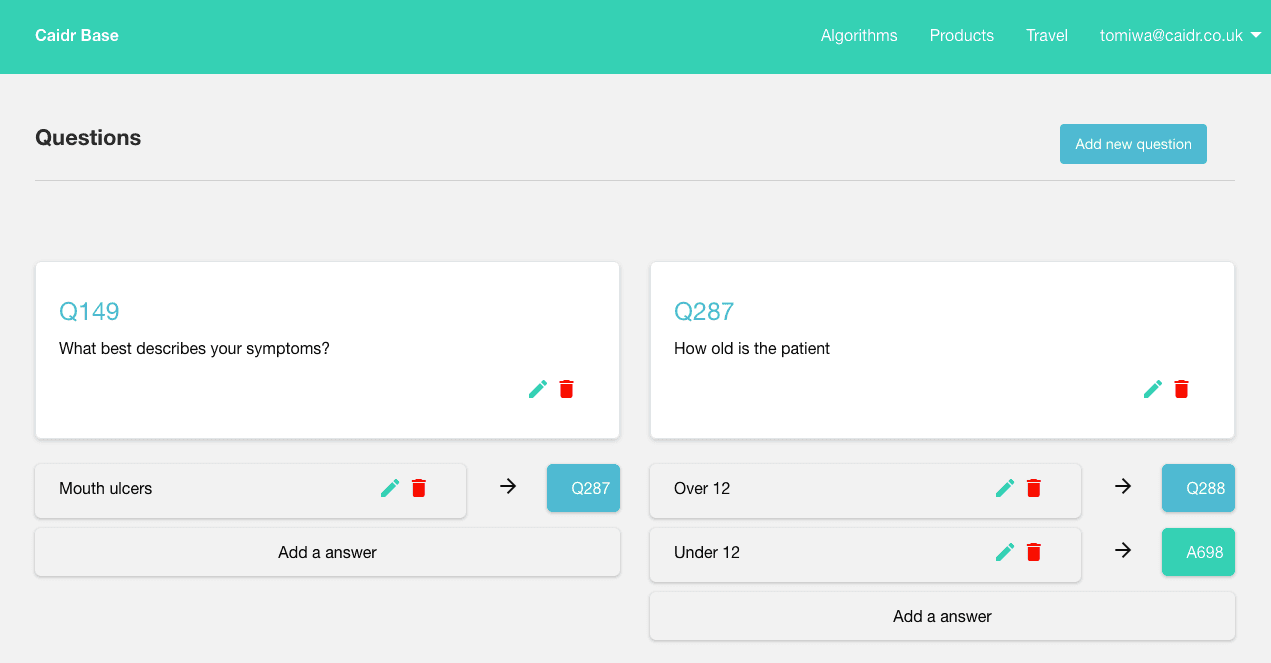
HealthWords made this concrete. Doctors and pharmacists authored clinical question paths and assessments inside purpose-built tools. Red flags could stop the automated route. A clinician could continue with the context already gathered. And specialist decisions could feed the benchmark used to test later system changes.
DESIGN THE SYSTEM
Make the operating rules explicit.
A dependable AI system is easier to build when the team can see the decisions, evidence, boundaries and ownership around it. The following principles turn an ambiguous ambition into components that can be implemented and reviewed.
Design human authority, not human availability.
Name the decisions a specialist must define, approve, take over or review. A person being somewhere in the workflow is not a control unless their authority changes what the system may do.
Put review at the decision boundary
Require human judgement before a consequential action, not after an unsafe result has already reached the user or changed a record.
Transfer evidence and state, not only a transcript
Include structured facts, sources, completed actions, unresolved questions, risk signals, system versions and the exact reason automation stopped.
Respect role-aware access
Different operators may need different views of sensitive context. Design the record and permissions together.
Turn reviewed outcomes into release evidence
A resolved case should improve the routes, rubrics and evaluation set. Otherwise the same uncertainty returns as manual work without making the system safer.
IMPLEMENT IN ORDER
Build the smallest complete loop.
Do not automate every adjacent task at once. Start with one valuable journey, carry it from signal to outcome, and preserve enough evidence to know whether it worked. Expand only after that loop is dependable.
- 01
List the consequential decisions
Start with decisions where a wrong route can harm a person, move money, change a protected record or create a regulatory obligation.
- 02
Assign authority for every route
Decide what specialists author before release, what automation may complete, what requires approval and what must always move to a qualified person.
- 03
Build the review packet
Transfer the relevant facts, evidence, actions, uncertainty, system version and decision required. Do not make the reviewer reconstruct the case from raw chat history.
- 04
Make takeover and fallback operational
Show who accepted the case, preserve a response deadline, constrain what happens while it waits and give the specialist the tools needed to continue immediately.
- 05
Close the learning loop
Review the final decision, label why automation stopped and add approved examples to the relevant route, rubric or release benchmark.
KNOW WHEN IT WORKS
Measure behaviour, not how impressive the demo looks.
The useful measure is whether the system creates the intended business or product outcome while staying inside its boundary. Review these checks before launch and whenever the model, data, prompt, tools or workflow changes.
Authority coverage
Every consequential decision has a named owner and the product can enforce when their judgement is required.
Intervention quality
The receiving specialist can identify the issue, evidence, risk and open decision quickly enough to change the outcome.
Continuity
The user does not repeat reliable information and the specialist can continue from the exact state where automation stopped.
Auditability
The team can reconstruct the evidence, automated actions, human decision and system versions behind the final outcome.
Release learning
Reviewed cases change future routes or evaluations instead of remaining isolated operational work.